
What The Bear Got Wrong – Analysing Russian Failures
We need reminded of their failures, and how far they have fallen…

In something of a sequel to my previous piece, this article will instead concentrate on Russian failures rather than successes. I hope it will provide appropriate counter points and framing, and as always, I welcome feedback; articles like this invite challenge, and I welcome the opportunity for learning and debate.
This article I think, is particularly important because of the ongoing issue of certain media outlets misidentifying Russian ‘successes’.
Pokrovsk, for example. Time and again it was reported as having ‘fallen’ over the last 6 months of 2025, yet it was only in December when eventually it could be described as under majority Russian control, and even at the point of writing this in late January 2026 the an advance past Pokrovsk has not materialised. Yet many media outlets remain unwilling to shift the reporting towards a more factual examination.
So this article will take a critical look at what hasn’t worked for Russia in its overall war with Ukraine; despite plentiful documented evidence, it seems necessary to point this out in the cold, hard logic of day-light…
Precision strikes
Before 2022, it was thought that the Russian military’s vast spending spree, which began shortly after the 2008 war with Georgia, had resulted in Russia developing a variety of precision strike capabilities on par with those of NATO and America.
SU-35 strike aircraft, armed with a variety of high-tech ordnance, could pinpoint command positions and, using the likes of satellite guidance and ground-based special forces, implement the kind of decapitation strikes that Western air force aircraft have been capable of for decades. Cruise missile launches could be directed from submarines, surface ships and ground-based launchers to strike at a variety of military targets with deadly and swift precision.
Russia could ‘shock and awe’ just like the Americans.
The February 2022 full scale invasion of Ukraine proved that no, they couldn’t.
Out-of-date or completely non-existent intelligence information resulted in many priority targets in Ukraine being completely missed, to say nothing of Ukraine’s own efforts to disperse their forces beforehand; dispersal that certainly saved precious lives and equipment.
True, certain locations were hit and destroyed, but it was not the kind of widespread devastation many analysts were expecting. The Ukrainian Air Force, in particular, continued to not just function but remain fully combat effective, and most army units got off lightly.
Today in 2026, SU-27 and MiG-29 Ukrainian aircraft continue to fly and fight, now augmented by F-16’s and Mirage 2000 jets provided by NATO; such aircraft have been reported as being completely wiped out numerous times by Russian propaganda.
‘Precision’ strikes still happen, but now more often than not they attack not military sites, but civilian; they are a component of a different Russian tactic; that of bombing civilians...
Terror bombing
It is an old idea; World War 2 saw the first use of large-scale ‘strategic’ bombing of cities. London was struck by the Luftwaffe, and the allied response, such as the conflagration of Dresden, has gone down in history as horrifying examples of terror bombing.
The Russians have taken a leaf out of the Nazi government’s ideas, and are flinging ballistic missiles, cruise missiles and drones at Ukraine’s cities in a seemingly ceaseless swarm, much as Germany did with V1 flying bombs and V2 ballistic missiles in World War 2.
No matter what cities are hit, no matter what casualties are caused, no matter what war crimes are recorded, Ukraine has remained defiant. The Ukrainian response? Their own precision strike campaign launched not at populated areas but at Russia’s most vulnerable spots; drone factories, oil processing terminals, munitions factories and other war-supporting industries.
So as Russia sees its ammunition and fuel blown up night after night, it’s oil terminals seemingly permanently on fire, Ukraine endures.
A belated attempt to strike at Ukrainian power-generating facilities has also failed; there are simply not enough missiles and drones to completely destroy all of Ukraine’s power-generating facilities this winter; just as there wasn’t in previous winters. Russia can make it hard for Ukraine’s population, and they have it hard indeed; yet the lion’s share of winter is over. Spring is on the way; they have got through the worst.
Never mind the fact that when it comes to power generation, the Ukrainians can do the same to Russia.
Nightly, it is not just Ukraine’s population who have suffered in the cold; the Russian region of Kursk has been struck by retaliatory strikes and even Moscow has seen blackouts.
What goes around comes around. Or To quote Babylon 5 “The Wheel turns, does it not, ambassador?”
The Human Safari
War crime after War crime. Incident after incident. Russian drone teams hunt civilians as well as military targets in Ukraine, especially around Kherson. These attacks are often referred to as ‘practice’ by Russian drone teams but the fact is, the Russian drone teams themselves are now primary targets for Ukraine.
Bounties for Russian drone operators now count higher than armoured vehicles; the hunters are now very much the hunted.
All the human safari has done is put a big red X on each Russian Drone operators head; now and after the war. Perhaps these men do not really comprehend that when will they ever sleep easy? They are war criminals and the Ukrainian intelligence services are highly unlikely to simply let bygones be bygones. Regardless of what kind of peace comes to pass in the future, Russia’s drone pilots will be forever marked men…
Kharkiv
Not just a region of Ukraine, not just a city of Ukraine but Kharkiv is also the name of a great and extensive Russian military reversal in the early months of the war.
From September 2022 to October 2022 the Ukrainian military conducted a series of highly successful counterattacks that broke the lines of Russian resistance and turned the Russian army away in the Kharkiv region. By October 2022 they successfully recaptured land all the way to the eastern city of Lyman.
Vast numbers of enemy troops and equipment were captured, and the retreat was passed off as an ‘olive branch’ during initial peace negotiations. It was nothing of the kind; it was a defeat.
How?
The Commander in charge of Ukrainian forces in Kharkiv was Oleksandr Syrskyi (the same Syrskyi who would go on to become the Ukrainian supreme military commander). Directing his forces, Syrskyi took advantage of Russian forces re-deploying to Kherson to oppose the Ukrainian counter offensive there. Exploiting gaps in the enemy lines, which had not yet been properly fortified, fast-moving Ukrainian military elements sweep through, advancing at one stage up to 20 kilometres a day (an unheard of rate of advance by the standards of the war today).
The failure here was that the Russian’s did not ‘go defensive’ to a sufficiently detailed degree. Ukrainian intelligence, sufficient troop numbers and vehicles, aggressive action and the good fortune of an enemy who was dividing his resources, resulted in an opportunity grasped and capitalized on.
Today, Russia hangs on to barely 20% of Ukrainian land…
Meat Waves and Infiltration
It was Wagner PMC, in its attacks towards the town of Bakhmut back in 2023, that first formalised the use of prisoners as cannon fodder. These men would be sent forward to draw Ukrainian fire so that follow on groups of Wagner PMC’s more well-trained units could direct the likes of artillery fire onto Ukrainian defensive positions.
When Wagner fell from grace, the Russian military “improved” the process, in a manner of speaking.
Now, instead of sending large single groups, they would send very small groups, two or three men at a time, to infiltrate through Ukrainian lines.
The Ukrainian response was the creation of the drone wall, a vast endeavour of FPV drones and reconnaissance drones watching for movement. When movement was detected FPV drones, were vectored in to kill individual Russian soldiers.
Day after day, week after week, month after month, these men would try and infiltrate through Ukrainian lines. When they did advance, whenever a certain number of them were able to congregate in certain areas they could consolidate the small incremental advances they were making and then continue on.
But the cost in blood and material is apocalyptic.
On some days, up to 2000 Russian soldiers become casualties. Even low-level advances could see thousands lose their lives for hundreds of metres.
Whether attacking in armoured vehicle thrusts, or two or three man teams operating often at night using special anti-thermal cloaks to try and mask their approaches, Russian soldiers are killed constantly and consecutively every single day.
Current estimates suggest that over 1,000,000 Russians have become casualties of the war in Ukraine, not to mention the over 10,000 armoured vehicles that Russia has lost.
And yet this tactic of feeding men into a meat grinder continues to be the preferred method for Russia to advance. Most recently, Wes O’Donnell was able to shine a light on Ukraine’s latest response to Russian advances; the ‘rope the dope’ method of allowing Russian units to attack and consolidate into positions and then be hit with formidable and powerful counterattacks that annihilate the attacking forces; the Ukrainian units then simply re-take the position and the process starts all over again. A tactic that reduces Ukrainian casualties, yet results in far higher casualties amongst attacking units; the latest claim being that 27 Russians were killed for every Ukrainian Soldier in the battles around Kupiansk.
A wasteful, bloody meat grinder of men, never given a chance to improve but just killed for metres of ground…
Sacrifice of the tank
10,000 armoured vehicles sacrificed for an additional 2% of land (Russia now occupies estimated 20% of Ukraine land. That’s 2% more than what it occupied before 2022).
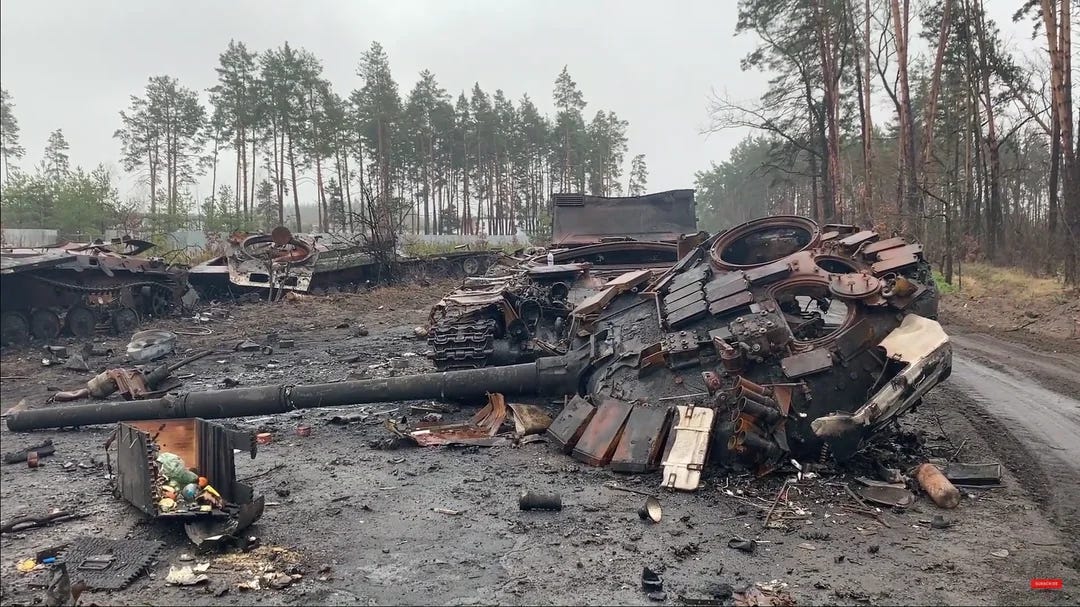
Despite all the drone defences and specially built ‘Barn’ or ‘bat tanks’, Russian tanks and armoured vehicles have continued to be destroyed at a considerably higher rate than Ukraine’s own.
Ukrainian tanks, often now Western produced variants, are still destroyed, captured or damaged. Yet to a far, far lesser degree than Russian armoured vehicles and with a far, far lower crew mortality rate.
Ukrainian crews of Western tanks have a considerably higher chance of surviving the disabling of their vehicles. Russians, by contrast, if their vehicle is struck in the wrong place, can expect to be utterly destroyed alongside their vehicles.
This means that Russia is not building up an adequate reserve of experienced tank crews. Certainly recent analysis would suggest that Russia can keep producing or reconditioning Russian tanks well into the future. Yet it will struggle to create a veteran tank Corps; it will continue to have to look to often ‘green’ (recently trained but not experienced) tank troops.
Attacks will continue to see huge casualties as inexperienced Russian troops advance down the same ‘high-ways of death’ time and again, to be cut to pieces by Ukrainian firepower...
Where is our air support?
During the civil war in Syria, the Russian Air Force was able to range above rebel held areas with relative impunity. Syrian rebels possessed very few anti-aircraft systems, so they could not adequately engage high-flying Russian strike fighters such as the SU-24 or more modern SU-34
This meant that Russia was free to refine its bombing procedures and did not have to worry about defensive manoeuvres. It also meant that in any given situation, Russian and pro-Assad Syrian forces could look for air support
Not so in Ukraine.
At a tactical level, Ukrainian forces had access to the likes of Stinger and other short-range anti-aircraft missiles that could easily engage low-flying jets and attack helicopters. At the same time, Ukraine had a fully operational integrated air defence network capable of engaging close support jets and other aircraft and air borne threats, at a variety of altitudes.
Since 2022, new air defence platforms have been constantly provided and set up in Ukraine by western allies. The most famous of which is arguably the ‘Patriot’ missile system provided by the United States.
This formidable, accurate and long-range anti-aircraft and anti-missile system has been defending Ukrainian airspace for years now, shooting down Russian cruise missiles, ballistic missiles and strike aircraft whenever it can.
Only in exceptional local circumstances can Russian forces rely on any kind of close air support. Otherwise, at the front line, the only air support that Russian troops can seek is that of individual drone teams and their FPV drones.
Even the formidable glide bombs launched from SU-34 strike aircraft, have in recent times found to be less and less effective due to Ukrainian jamming, and there deployment still puts the SU-34 strike aircraft that launch them in peril from the potential interception by Ukrainian’s F-16 fighter aircraft or a hidden Patriot battery.
Effectively, with such a hostile air-defence environment, the average Russian soldier does not, on average, have close air support...
The drone broke it
Before the 2022 full-scale invasion of Ukraine, Russia was documented as having an extensive electronic warfare advantage. Dozens of different types of electronic warfare systems were available to the Russian military; it was world regarded as being well ahead of the EW game.
These systems could disrupt communications networks at the frontline and beyond, giving Russia a critical advantage.
Yet to the surprise of many, a great number of these highly advanced electronic warfare systems have been targeted and destroyed by the very assets that they are designed to combat. Drones.
Video after video has surfaced of everything, including the most humble of FPV drones, targeting and destroying Russian electronic warfare systems, including their most advanced variants.
The fact is that even the most powerful electronic warfare system cannot blanket disable every single wavelength, otherwise Russia’s own systems would cease to function. Therefore Ukraine has become adept at figuring out which wavelengths the Russians are not jamming and using that wavelength at that particular time to strike. Rapid signal hopping has allowed the likes of grenade dropper drones and FPV drones to hit these highly expensive electronic warfare systems. This costs Russia dearly, particularly in the realm now where sanctions prevent the easy acquisition of needed electronic warfare equipment.
The game continues as Artificial Intelligence, civilian radio and mobile networks and other automation processes are used and improved over time to keep the edge of Ukraine’s drone innovation. Russia can certainly out-produce Ukraine on a variety of drone variants, but it still has serious issues out-innovating an inventive population fully opposed to its invasion…
Kursk
The debate over the usefulness of the Kursk offensive by Ukraine will continue long after the War in Ukraine is over.
Some see it as no more than a political stunt, meant to maintain Western support and a waste of good Ukrainian infantry. Others see it as an effective counter attack at the right time, and a successful one. Whilst Ukraine did not hold Kursk indefinitely, they did become the first army to successfully enter and capture parts of Russia since World War 2.
The Kursk offensive, which lasted from August 2024 to around March 2025, started with a surprise attack into that region of Russia. It was such a shock that Russian border troops appeared completely unprepared for. Despite warnings of Ukrainian troop buildups, Russia does not appear to have considered the possibility that Ukrainian troops would cross at the border, and as a result, border guards and local , mostly conscript-manned army units were caught by surprise.
Within days, General Syrskyi was announcing that over 1000 square kilometres of Russian territory had been captured and the principle town of Sudzka secured along with dozens of other settlements.
To have allowed parts of Russia to be captured by the very country that Russia was itself invading was bad enough. What happened next from a reputational point of view was even worse, despite the decision being self inflicted.
Russia allowed the deployment of North Korean troops into Kursk, both artillery units and elite North Korean infantry units. Ukraine found itself in the unusual position of fighting North Korean troops defending Russian land.
Ultimately, the effort would succeed; Ukraine eventually retreated from Kursk in March 2025.
Yet the offensive will be remembered for the reputational damage to Russia. It failed to defend its land and needed troops of another foreign power to adequately fight off the same nation it has invaded in the first place.
Russia, that mighty empire, had to ask another decrepit regime for help…
Moskva
The title of this section is a little misleading, as the sinking of the ‘Moskva’ was not the only defeat the Russian Navy in the Black Sea would suffer.
The Russian flagship, Moskva, a Slava class guided missile cruiser, was sunk by Ukrainian Neptune Anti-ship cruise missiles on the 14th April 2022. Just this January, deleted Russian court documents acknowledge for the first time that it was the Ukrainians, not an ‘accident’, that sunk this powerful Russian warship.
This comes hot on the heels of a sea-drone attack that has likely crippled a Russian Kilo Class submarine that was docked in the previously thought to be relatively safe harbour of Novorossiysk.
To say nothing of the fate of another Kilo class, the Rostov-na-Donu hit by Ukraine in 2023 and then after repairs, hit again in 2024 and possibly sunk.
But wait, these surely aren’t so much failures as just naval losses? Why list them under the mockery of failures?
Simple, because they are naval losses inflicted by a country (Ukraine) that hardly has a functioning navy. At the time of writing, Ukraine has 27 ships in its navy, the majority of which are small surface ships and no submarines; the Black Sea fleet fields half a dozen submarines and at least 5 guided missile frigates; surely more than enough to at least contest the Black Sea and threaten Ukraine?
Instead, via clever use of cruise missiles and drones, Ukraine hasn’t just denied naval dominance to Russia; it has functionally defeated the Russian Black Sea Fleet. That is a catastrophic failure for Russia and with its powerful navy in the Black Sea, should not have happened…
Conclusion
Russia has got a lot right and slowly, is certainly innovating and applying its own Lessons Learnt, corrupted as those lessons are.
Drone production has been optimized and is on the rise. Rubicon, its elite drone unit, is an effective strategic asset. Its economy is running hot but stable and continuing to hold despite extensive pressure. The Shadow Fleet continues to operate despite sanctions and Ukrainian attacks.
Russian has got a lot right and could still snatch a win.
But the Bear is not immortal nor invincible. It is a bloodied, wounded beast lashing out. Pressure is ticking up and up; America may not be a reliable partner but European support continues despite Trump’s recent distraction with Greenland.
2026 may yet be Ukraine’s year, if Russia’s many failures can be capitalised on…
An excellent summary of Russian failures in Ukraine. I remember hearing a lot about Russia “fixing” the deficiencies in their military post-Georgia, but it seemed that didn’t really pan out. Especially in a technical sense, as you mentioned with precision munitions. Really loved the airpower section, their airpower experience over Syria didn’t really translate to Ukraine…